How Funding Schools Happens Across the US: A Maine Perspective
Public education in the United States is funded through a layered system that blends local, state, and federal dollars, but the balance of those sources varies dramatically by state and those differences shape everything from tax bills to classroom opportunity. Nationally, the federal government contributes only a small share distributed through state and federal programs, roughly 8–13%, with the rest split between state and local governments. What makes Maine distinct, particularly for small towns along the Midcoast, is just how heavily the system leans on local property taxes, and the consequences that follow from that reliance.
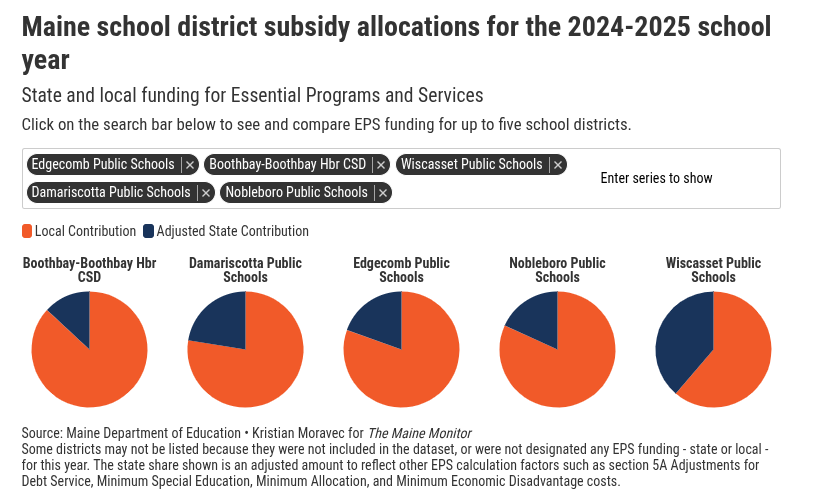
In Maine, the structure is relatively clear on paper, the state provides 55% of total expected funding with local municipalities shouldering the rest. While Maine voters have long pushed for the state to fund 55% of education costs through the Essential Programs and Services (EPS) formula, many districts fall short of that benchmark in practice. (Bangor Daily News) The result is that local taxpayers continue to bear a disproportionate burden. Property taxes themselves are already among the highest in the nation relative to income, reinforcing the central role they play in funding schools. (The County)
This reliance becomes even clearer when looking at how property taxes are used locally. In many Maine communities, education accounts for the largest share of the property tax bill, often around two-thirds of local spending. For towns like those in the Midcoast, including communities similar to Edgecomb, this means that school budgets and municipal tax rates are tightly intertwined. When school costs rise (whether due to staffing, transportation, or special education) property taxes tend to rise with them.
Across New England, Maine is not alone in relying on property taxes, but there are meaningful differences. States like Massachusetts and Connecticut still depend on local taxes, yet they generally provide stronger and more consistent state-level funding through income and sales taxes, which helps equalize disparities between wealthy and less wealthy communities. Meanwhile, neighboring New Hampshire stands out for its lack of a broad-based income or sales tax, relying heavily on property taxes as well, but with different structural choices and policy outcomes that shape education spending and local control.
Looking more broadly across the United States, most states attempt to balance equity and local control by relying more heavily on state-level funding streams such as income taxes, sales taxes, or statewide education formulas. These mechanisms allow states to redistribute resources so that districts with lower property values can still fund schools at comparable levels. However, even with these systems in place, disparities persist, particularly in rural areas where property wealth is limited.
Another important but often overlooked component of education funding comes from land-grant institutions, rooted in the Morrill Land-Grant Acts. These acts granted federal land to states to establish colleges focused on agriculture and the mechanical arts, creating long-term revenue streams and institutional support for education. While these funds primarily support higher education systems, such as the University of Maine System, they represent an alternative model of education investment that is less dependent on annual taxation and more tied to asset-based funding. This stands in contrast to K–12 systems, which largely lack comparable endowments and instead rely on recurring tax revenue.
Each of these funding models carries its own advantages. Maine’s approach, grounded in local property taxes, provides strong local control, allowing communities to make decisions aligned with their values and priorities. It also creates transparency; residents can clearly see how school budgets affect their tax bills. In contrast, systems that rely more heavily on state income or sales taxes can provide greater equity and stability, smoothing out differences between wealthy and less wealthy districts and reducing the volatility tied to local property values.
However, the drawbacks of Maine’s model are particularly acute in small Midcoast towns. First, communities with limited commercial tax bases or lower property valuations struggle to raise sufficient funds without placing a heavy burden on homeowners. Second, towns with valuable waterfront or seasonal properties may appear “wealthy” on paper, reducing their state aid, even if year-round residents have modest incomes. This creates a structural imbalance where ability to pay does not align with property valuation. Third, the system can lead to budget instability and voter fatigue, as residents are asked to approve rising school budgets year after year, often resulting in contentious town meetings and rejected budgets.
Finally, Maine’s reliance on property taxes ties school funding to broader demographic and economic trends. Declining enrollment, aging populations, and rising property values can all distort the funding formula, making long-term planning difficult for both school boards and taxpayers. These pressures are particularly visible in rural and coastal communities, where economic growth is uneven and population shifts are pronounced.
For those looking to better understand and evaluate these systems, several resources are worth exploring. The National Center for Education Statistics provides comprehensive national and state-level funding data. USAFacts offers accessible breakdowns of funding sources by state, including Maine-specific figures. At the state level, the Maine Department of Education and organizations like Maine Center for Economic Policy publish analyses of the EPS formula and funding equity.
Understanding how schools are funded is ultimately about more than budgets; it is about values. Maine’s system reflects a deep tradition of local control, but it also exposes small towns to structural challenges that are increasingly difficult to manage. As communities like those along the Midcoast look to the future, the central question remains: how to preserve local voice while building a funding system that is fair, sustainable, and resilient in the face of change.