Maine School Testing and the Impact on Edgecomb
School testing in Maine is designed to provide a consistent, statewide snapshot of student learning, but understanding what those results actually mean, especially in a small town like Edgecomb, requires context, nuance, and a broader view of school performance. Through the Maine Comprehensive Assessment System (MECAS), students in grades 3–8 participate in the Maine Through Year Assessment in reading and math, administered in multiple windows throughout the school year (fall, winter, and spring), while science is assessed in grades 5, 8, and once in high school. These tests are typically computer-based and designed to measure not just rote knowledge, but applied skills and problem-solving. They are administered locally by classroom teachers and trained staff, but aligned to state and federal accountability requirements. Importantly, Maine’s own Department of Education consistently emphasizes that these results should not be viewed in isolation, they are just one data point among many and should be considered alongside classroom performance, teacher insight, and student growth over time.
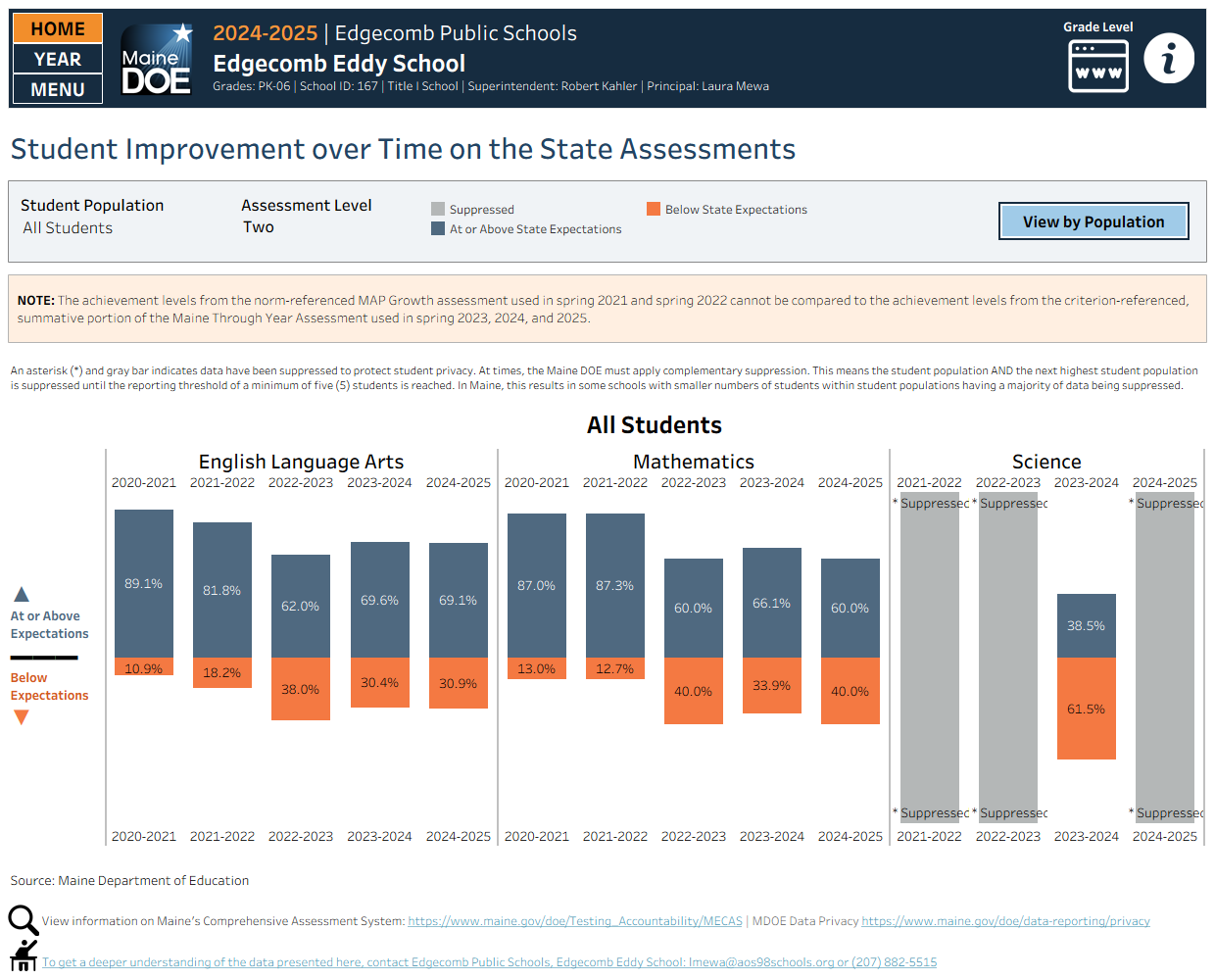
What makes interpretation especially challenging in a small district is scale. With roughly 104 students total and sometimes only a dozen or fewer in a tested grade, the performance of just one or two students can shift proficiency percentages dramatically from year to year. This creates natural volatility that can make trends look more dramatic than they truly are; what appears to be a “drop” or “spike” may simply reflect normal variation in a very small sample size. In that sense, test scores in a community like Edgecomb should be read more like a snapshot than a definitive trend line.
For families and community members looking to better understand school performance, there are several valuable sources beyond standardized testing. The Maine Department of Education’s ESSA dashboard provides insight into student growth, attendance, and chronic absenteeism. School reporting and AOS reporting often include information on demographics, class sizes, and programming. Classroom-level indicators (student work, report cards, and teacher communication) often provide the most immediate and meaningful feedback. Additionally, factors like student-teacher ratios, enrichment opportunities, and school climate all contribute to outcomes but are not captured in a single test score.
Ultimately, Maine’s testing system plays an important role, but it is only one lens. In small, close-knit school communities like Edgecomb, a measured and informed approach, grounded in multiple data sources and an understanding of local context, is essential to telling the full story of student learning and school success.